What AI Needs That $700 Billion Can't Buy
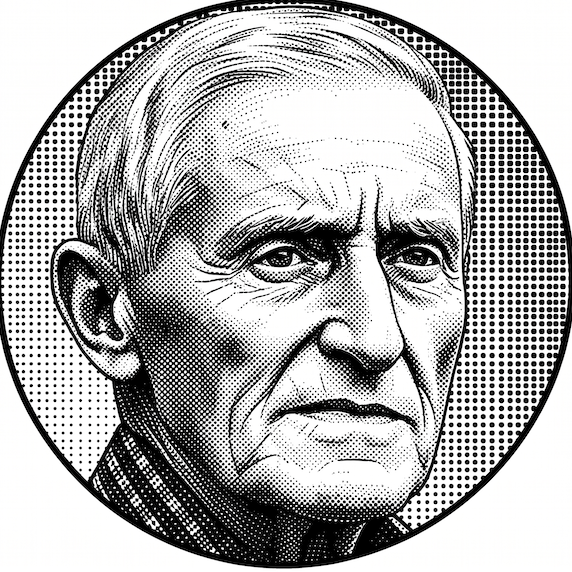
Mervin Raudabaugh is 86. He farms 261 acres in Silver Spring Township, Pennsylvania, about ten miles west of the state capital of Harrisburg. A data-center developer offered him $15 million for the land, sixty thousand dollars an acre. That is several multiples of market. He turned it down. He sold the development rights through a county farmland preservation program instead, for about $1.9 million.
He is not the only one. A Kentucky family, name withheld from the reporting, rejected a $26 million anonymous offer for 600 acres, at roughly $43,000 an acre against local farmland comps near $6,000. Tim Grosser, also in Kentucky, turned down $8 million for 250 acres in December 2025.
Most landowners offered these multiples sell. The ones who didn’t are the signal we’re examining. In 2023, 69% of Virginia voters told pollsters they supported new data centers in the state. By early 2026 the number had fallen to 35%, a 34-point collapse in three years in the state with more operating data-center capacity than any other.
I have been curious about the “what must be true” for these data centers to be brought online, and what, if anything, is in the way. What I found is the AI buildout is being slowed by people declining the offer, some on their porches, some on planning commissions, some at the trading floor of a capacity auction. Behind the human refusals sits a supply chain that would struggle to deliver even if every refusal were reversed tomorrow. The AI buildout, as I learned, is a bigger test of our entire economic, political, and societal priorities.
Seven hundred billion
There are yacht-loads of money on the table looking for more capacity. The question this section works through is whether the money can actually buy what it is being spent on, and whether the output of that spend will price where the spend needs it to.
The announcement
Amazon is spending $200 billion in 2026. Google, about $180 billion. Meta, $115 to $135 billion. Microsoft, $110 to $120 billion. The combined figure lands between $660 and $700 billion, depending on whether you include Oracle and how you treat operating leases. Call it seven hundred billion dollars over twelve months, three-quarters of it AI infrastructure. These are announced numbers; not all of it will be committed and not all of it will be spent. But the direction is what it is.
Amazon was at $125 billion the year before. Meta nearly doubled. This is the fastest capex ramp in the history of corporate America, aimed at the fastest infrastructure buildout in the history of the U.S. electrical system.
The capital side
Capital was supposed to be the easy input. It is not, anymore. Free cash flow is compressing across three of the four hyperscalers, and the bond markets and the layoff queue are carrying the gap.
Deep DiveWhy capex this size is straining the capital itself, even now
The capital side of the story has moved since the summer. 2026 hyperscaler capex runs close to 90% of operating cash flow across Amazon, Google, Meta, and Microsoft, against a ten-year average near 40%. When the four reported the first quarter of 2026 in late April, the guidance moved up rather than down, pushing the combined number closer to $725 billion. Amazon is on track for negative free cash flow between $17 billion (Morgan Stanley) and $28 billion (Bank of America). Alphabet’s free cash flow is expected to fall from $73.3 billion in 2025 to about $8.2 billion in 2026, a roughly 90% collapse. Meta’s FCF is projected to fall by roughly the same order. Microsoft is the lone hyperscaler Evercore expects to grow free cash flow this year.
The bond markets are carrying the difference. Alphabet raised $25 billion in a single November 2025 sale and its long-term debt quadrupled to $46.5 billion in 2025. CreditSights forecasts roughly $93 billion in hyperscaler dollar bond issuance in 2026.
The labor side has moved in the other direction. On April 23, Meta told employees it will lay off 8,000 people, ten percent of the workforce, starting May 20, and will close another 6,000 open roles. The memo from the chief people officer cited running the company more efficiently “while balancing other investments.” Meta’s 2026 capex guidance went up in the same quarter. Microsoft paired its own announcement with a voluntary retirement plan; chief people officer Amy Coleman wrote that the program “gives those eligible the choice to take that next step on their own terms, with generous company support.” Between the two companies the figure reaches roughly 20,000 positions, and Layoffs.fyi has tracked more than 92,000 tech layoffs across the sector so far in 2026. A 2026 Motion Recruitment study found that AI adoption is slowing hiring for entry-level and generalized IT roles while bidding up AI-specific positions; the layoffs land on the half of the workforce AI can already substitute for. Capex is rising while headcount is falling in the same quarter, and the bond market is carrying the gap.
None of this makes capital the binding constraint the way a missing electrical transformer is. It does make the “capital is the easy input” framing from six months ago out of date. The buildout is now tight enough at the margin that hyperscalers are funding silicon by letting go of people.
The token side
The demand side of the bet moved yesterday. DeepSeek released a frontier-class open-weight model priced at roughly one-seventh of the U.S. equivalents, and the mechanism behind the pricing is energy, not margin.
| Model | Input $/M | Output $/M |
|---|---|---|
| DeepSeek V4 Flash | $0.14 | $0.28 |
| GPT-5.4 Nano | $0.20 | $1.25 |
| Gemini 3.1 Flash-Lite | $0.25 | $1.50 |
| Gemini 3 Flash Preview | $0.50 | $3 |
| GPT-5.4 Mini | $0.75 | $4.50 |
| Claude 4.5 Haiku | $1 | $5 |
| DeepSeek V4 Pro | $1.74 | $3.48 |
| Gemini 3.1 Pro | $2 | $12 |
| GPT-5.4 | $2.50 | $15 |
| Claude Sonnet 4 / 4.5 | $3 | $15 |
| Claude Opus 4.5 | $5 | $25 |
| GPT-5.5 | $5 | $30 |
Deep DiveWhy tokens price against the cost of energy, and why that matters now
On April 24, 2026, DeepSeek released V4-Pro and V4-Flash as open-weight previews under a permissive license. V4-Pro is a 1.6-trillion-parameter Mixture-of-Experts model with 49 billion active parameters and a 1-million-token context window. On benchmarks it matches GPT-5.4 on MMLU-Pro, leads the field on LiveCodeBench (93.5) and Codeforces (3206), and trails on factual QA. It is optimized to run on Huawei Ascend 950PR silicon rather than Nvidia, the first frontier-class model released Ascend-ready.
V4-Pro sells for $1.74 per million input tokens and $3.48 per million output tokens. Claude Opus 4.5 sells at $5 and $25. GPT-5.5 sells at $5 and $30. Output pricing for the frontier-class Chinese model is roughly one-seventh of the frontier-class U.S. models it benchmarks against.
Training is electricity plus silicon depreciation. Inference is electricity plus silicon depreciation plus serving overhead. Once quality is comparable and weights are open, the price of a token settles toward the cost of the energy and the chip that produced it. U.S. AI is priced against U.S. cost of energy, which this essay documents going up: PJM at the legal cap, coal retirements deferred, gas turbines booked through 2030, a new rate class carved out of residential bills. Chinese AI is priced against Chinese cost of energy, formally designated a national priority under the phrase “computing-electricity synergy” in China’s 2026 work report.
The substitution is already landing. On OpenRouter, Chinese models reached 61% of token consumption in February 2026, and still ran near half the market by mid-year. The cheap-intelligence layer has migrated; V4-Pro is the first frontier-class drop into the migration zone.
The $700 billion assumes pricing power on the output side sufficient to amortize four-year-depreciating GPUs, deferred coal retirements, residential rate transfers, and bond interest. If the price of a frontier token halves or quarters over twelve to twenty-four months on demand-side substitution, the amortization math breaks. The supply side of this buildout is running into physical constraints this essay catalogs for the rest of the piece. The token side is running into a price floor set in Chinese kilowatt-hours, and that floor is structurally lower than the one U.S. hyperscalers are building on.
Microsoft is the only Mag 7 hyperscaler Evercore currently expects to grow free cash flow in 2026. Compress the output price of a token by three to five times on substitution, and that forecast inverts too.
The precedent
The closest economic analogue is the dotcom/telecom buildout a generation ago, when private capital poured into physical infrastructure at a pace no forecaster had modeled. Peak telecom capex was about $120 billion in 2000, roughly $213 billion in today’s dollars. The 2026 hyperscaler number is $700 billion.
Deep DiveHow the 2026 buildout compares to the 2000 telecom overbuild, and why the comparison matters
Between 1996 and 2000 the telecom industry spent roughly $500 billion laying fiber and building backbone. Much of it rested on WorldCom’s claim that internet traffic was doubling every 100 days. Actual traffic doubled roughly once a year. The bubble popped in 2001 and the equity was torched.
Four years after the crash, about 85% of the fiber laid in the 1990s was still dark. Most of it eventually carried Netflix and Google traffic in the 2010s, once Level 3 and Global Crossing had been bought at pennies on the dollar. Capital was torched, and the infrastructure turned out useful anyway.
The 2026 buildout is about three times that peak in today’s dollars, and it rests on assets that do not keep. A GPU depreciates in four to five years, not thirty. Transformer and turbine plant will persist, but the costs being pushed onto the public grid are not like dark fiber sitting in a conduit waiting for a streaming service to discover it. A coal plant kept running past its climate date does not give those tons of carbon back. Groundwater drawn from a stressed aquifer does not refill on the schedule an earnings call prefers. The 1999 overbuild left a fiber network. The 2026 overbuild is leaving a ratepayer transfer, an airshed a mile from an elementary school, and a set of externalities that do not become more useful over time.
The signals
Most of the reporting on the boom fixates on GPUs. Most of the money goes elsewhere. Nvidia’s most expensive GPU is useless without an electrical transformer, and the transformer is where the schedule breaks.
A few signals have already slipped through the spreadsheets. AWS delayed parts of its data-center lease portfolio in early 2025. Oracle pushed construction completions from 2027 into 2028 and named labor as one reason. Those are schedules meeting a supply chain.
And in December, the grid operator that serves the largest U.S. data-center corridor ran a capacity auction that hit the legal price cap for a second consecutive year and came up 6,600 megawatts short of its own reliability requirement. The first time in its history. The details live a few sections down. The point for now: the numbers on the press release and the numbers on the electricity market are starting to diverge.
The 38-year-old electrical transformer
A large power transformer is the thing that makes a high-voltage grid possible. It steps voltage up for long-haul transmission, and back down for local distribution. Every substation on the grid has one, and the largest weigh hundreds of tons and take half a year to install.
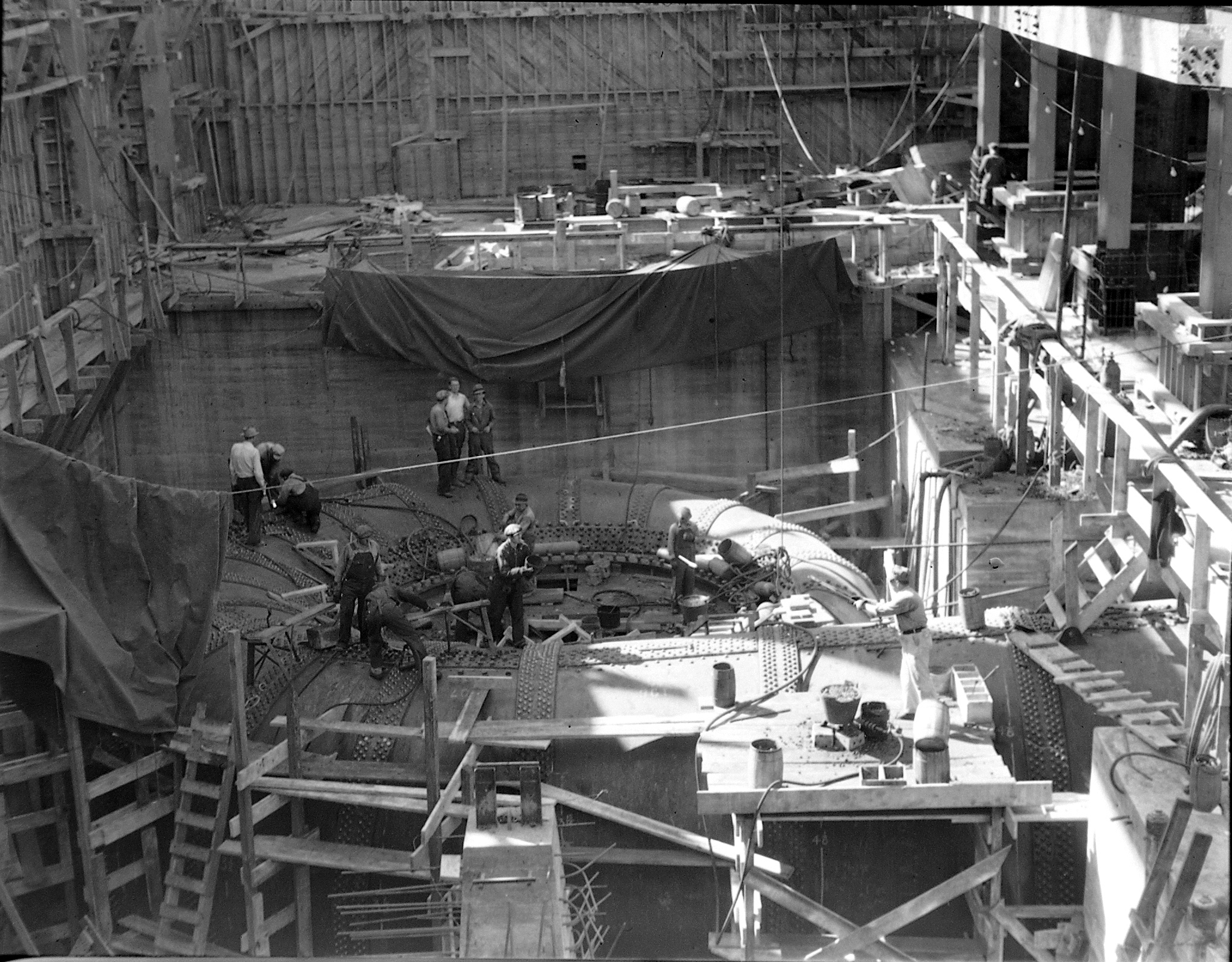
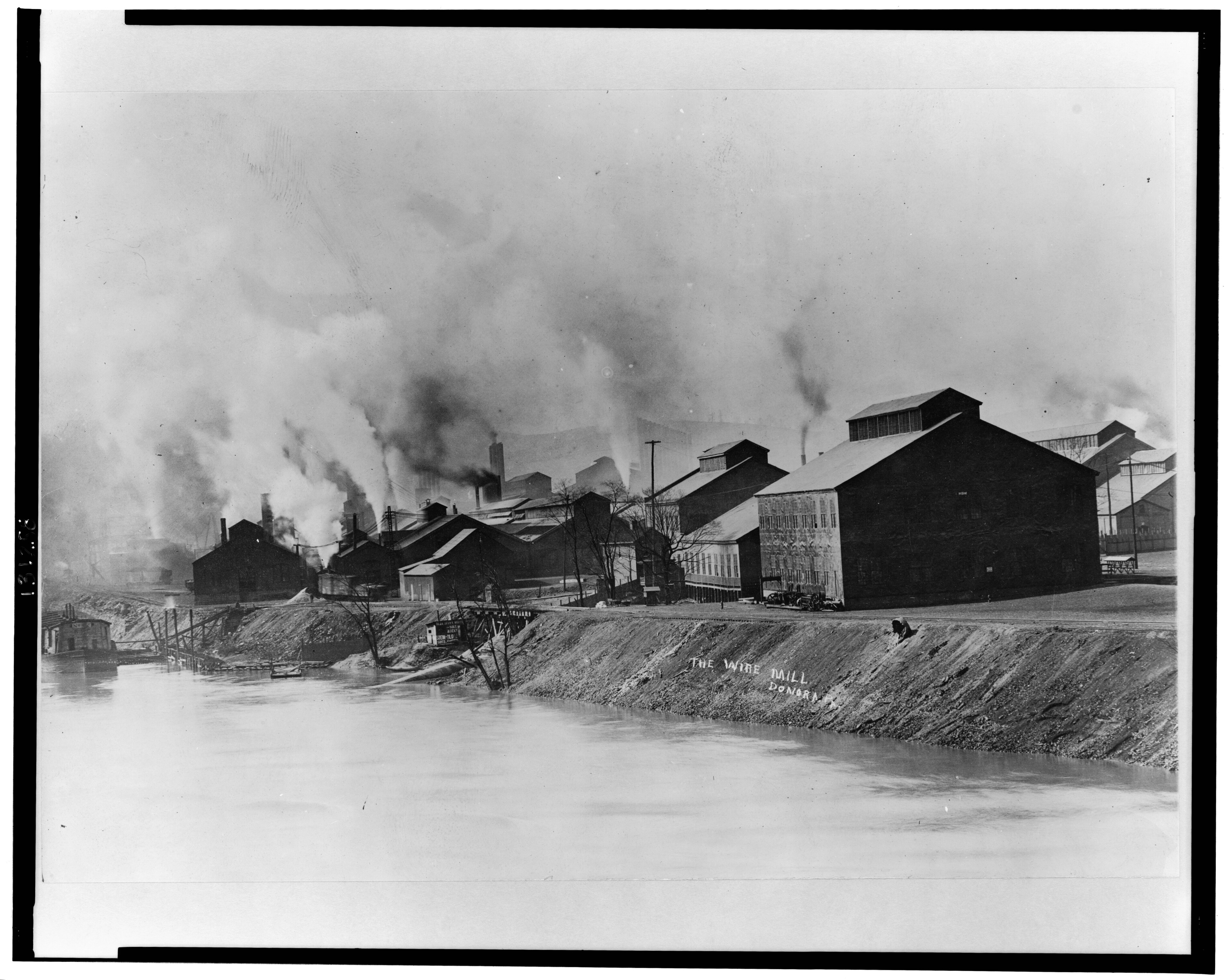
The core of that transformer is made of one very specific kind of steel, and in the United States it comes from one plant. Butler Works in Butler, Pennsylvania, owned by Cleveland-Cliffs, is the only American producer of grain-oriented electrical steel. There is no second supplier, and no second plant.

Deep DiveWhy only grain-oriented electrical steel works, and why only Butler rolls it
A transformer works by pushing magnetic flux through an iron core, back and forth, sixty times a second. The more easily the flux moves, the less energy is lost to heat. The trick is to roll iron and silicon together under heat and pressure until the crystal structure aligns in a single direction. That alignment, the thing the word “grain-oriented” means, lets flux pass with minimal loss in the rolling direction. No other alloy works at utility scale.
Butler, Pennsylvania is a town of about 13,000 people twenty miles north of Pittsburgh. It has been rolling electrical steel since 1927, when ARMCO acquired a specialty mill there. The mill passed to AK Steel in the late 1990s, and Cleveland-Cliffs bought AK Steel for $1.1 billion in March 2020.
Cleveland-Cliffs is expanding Butler Works, spending $195 million on new capacity, supported by a $75 million Department of Energy grant. In April 2024 the DOE finalized a distribution-transformer efficiency rule that was specifically rewritten so the new standard “can primarily be met with GOES, the majority of which will be manufactured in the United States”. That’s industrial policy written by engineers rather than legislators, centered on a single plant.
The average large power transformer on the U.S. grid is at least 38 years old, on a design life of about 40. That number comes from the Department of Energy’s 2014 fleet-wide study. The DOE has not published a newer one, and twelve more years have passed. The real average is almost certainly higher.
The lead time to get a new one is 128 weeks for a power transformer and 144 for a generator step-up unit, per Wood Mackenzie’s Q2 2025 survey. Roughly two-and-a-half to three years. In 2020, the lead time was a few months. Prices are up about 77% since 2019, nearly double, and that is enough.
The United States is building new transformer capacity. Hitachi Energy has broken ground on a $457 million plant in South Boston, Virginia, to open in 2028. Siemens is building a plant in Charlotte that has slipped its first transformers from early 2026 to 2027. Prolec GE is doubling a facility in North Carolina. Eaton is putting $340 million into a three-phase plant in South Carolina that starts in 2027. Roughly $2 billion in announced capacity, and all of it now ships after the current hyperscaler capex window closes.
The hyperscalers building through 2027 are sourcing transformers outside the domestic supply line. The channels include slot-swaps with utility customers (the utility reorders two years further out and the delay lands on the rate base), imports from Hyosung and Iljin in Korea and Prolec Monterrey in Mexico (freight and tariff land inside the power-purchase contract), refurbished units pulled from decommissioned generation, and lower-voltage specifications that shorten the queue at the cost of more substations. The absence of domestic supply is being paid for one customer at a time.
The 38-year-old transformers are being maintained by 58-year-old men, and both of them are tired.
Chokepoints to watch
Butler Works is not unique. The AI stack is built on single points of failure from top to bottom, and most of them are concentrated in one town, one company, or one country with no qualified alternative.
The machines that print the transistor patterns on every leading-edge chip are built in Veldhoven, Netherlands, by ASML. The optics come from Zeiss in Oberkochen, Germany. The drive laser comes from Trumpf in Ditzingen. Each subsystem is single-sourced, and Trumpf’s Peter Leibinger has described the arrangement as a “virtually merged company.” ASML recognized revenue on 44 EUV systems in all of 2024. Each one costs between $200 million and $400 million depending on the node, and they are the only way to make a 3-nanometer chip. Forty-four machines, out of one town, are the world’s entire supply of leading-edge patterning capacity in a year.
The packaging step that glues a Blackwell GPU to its memory stacks is called CoWoS. Every Nvidia H100, H200, and B200 ships through it. TSMC in Taiwan is the only operator with volume. CoWoS capacity is scheduled to roughly double year over year through 2026, reaching around 130,000 wafers per month, and it is still fully booked. Nvidia has reserved more than half of 2026 output by itself.
The memory that sits next to the GPU, HBM3E, is a Korean story in one company’s favor. SK Hynix holds about 62% of HBM shipments per TrendForce’s tracker. Samsung’s share fell from roughly 41% a year earlier to 17% after failing Nvidia’s HBM3E qualification tests for eighteen months. Samsung passed in September 2025. Through most of 2024 and 2025, one Korean company gated Nvidia’s entire product ramp.
The fused-quartz crucibles used to grow every monocrystalline silicon ingot in the world come, overwhelmingly, from one town in North Carolina. Spruce Pine, population about 2,200, sits on a geological deposit of ultra-high-purity quartz that has no substitute at scale. Sibelco and The Quartz Corp mine it. When Hurricane Helene dumped two feet of rain on Spruce Pine on September 26, 2024, both operators halted production. The town lost water and power for more than a week. Wafer fabs worldwide were saved by crucible inventory already in the supply chain, and by the outage clearing inside three weeks. A six-month outage would have stopped the industry.
The dielectric film laminated into the substrate under every Intel Xeon, AMD EPYC, and Nvidia data-center chip is made by Ajinomoto, the MSG company. In the 1990s Ajinomoto’s chemists noticed that a byproduct of amino-acid manufacturing had unusual dielectric properties, and adapted the resin into a film for chip substrates in 1999. Ajinomoto Build-up Film has held more than 95% of the CPU and GPU substrate market since. The chip crunch of 2020 to 2022 was partly a shortage of it.
Any one of these chokepoints, a storm in Appalachia, an export license in The Hague, a qualification failure in Hwaseong, can stall the whole build. Capital cannot unbuild a geological deposit or reformulate a photoresist chemistry in twelve months. The chokepoints are not listed on any earnings call.
The auction
Those are the chip-side chokepoints. The power-side chokepoints are the same shape. They clear through a capacity market rather than an export license or a photoresist supplier, and in December 2025 that market ran the auction that defined the year.
December 17, 2025. PJM Interconnection, the regional grid operator that covers thirteen states from New Jersey to North Carolina (Dominion’s Virginia territory among them), closed its annual capacity auction. The clearing price hit the legal cap of $333.44 per megawatt-day for the second year in a row. Total cost: $16.4 billion. The auction came up 6,600 megawatts short of the reliability requirement, the first shortfall in PJM’s history. Data centers accounted for 40% of the cost and nearly all of the 5,250 megawatt load-forecast increase.
Deep DiveHow a capacity auction works, and how PJM's got to the cap
A capacity auction sells availability. A generator agrees to be online and responsive on the worst day of a future year, and gets paid for the commitment whether it ends up running or not. Electricity itself, the megawatt-hours that actually move, is priced separately in a different market. A ratepayer is buying the fire department a retainer.
PJM runs one because wholesale energy markets, under deregulation, did not signal enough investment in generation that would rarely run but had to exist anyway. Economists called it the “missing money” problem. PJM filed its Reliability Pricing Model at FERC in August 2005, ran its first auction in April 2007, and has held one almost every year since.
The mechanics are simple enough. Generators submit sealed sell offers. PJM crosses those offers with an administrative demand curve calibrated to a 1-in-10-year reliability standard. Everyone who clears is paid the same clearing price. Load-serving utilities buy the capacity and pass the bill through to ratepayers. The price is capped at Net CONE, the theoretical first-year revenue a new combined-cycle plant would need to pay for itself. For the 2027–28 delivery year that number is $333.44 per megawatt-day.
Clearing prices sat between roughly $30 and $140 per megawatt-day for a decade. The 2025–26 auction jumped to $269.92. The next two hit the cap. Three things moved at once: about 6,600 megawatts of mostly-coal retirements pulled supply down; FERC Order 2023’s queue reform slowed new entry to a crawl; and PJM’s load forecast for 2027–28 jumped roughly 5,250 megawatts, of which data centers were about 5,100. PJM’s own market monitor attributes roughly 40% of the $16.4 billion cost to data-center load, most of it from projects not yet built.
At the legal cap, for the second year in a row.
Paid by load-serving utilities and passed through to ratepayers.
The first shortfall in PJM’s history.
Of the $16.4 billion, per PJM’s independent market monitor.
For the first time in the operator's history, the auction failed to procure enough supply for the reliability requirement. Sources: PJM Interconnection, Utility Dive, NRDC.
This is the market saying no the way a mortgage application says no. PJM’s own independent market monitor argues the auction design amplifies the price signal (ELCC methodology, Capacity Performance penalties, a twelve-month-old load forecast). The physical inputs, in lead times and queue slowness, make the signal louder either way.
The generation side of the equation is not easier. Large gas turbines are the fastest way to add dispatchable power to the grid, and they now have 5-to-7-year lead times. GE Vernova, Siemens Energy, and Mitsubishi Power are booked through 2030. One U.S. plant has quoted as much as a seven-year wait on new orders. GE Vernova announced $600 million in new U.S. manufacturing investment in January 2025, with $300 million of that aimed at lifting gas-turbine capacity toward a target of 80 turbines per year. Analysts do not expect meaningful lead-time relief before 2027, or meaningful new generation before 2030.
The next-best option is nuclear, and the nuclear story is a study in how hard it is to restart physical things once you have paused them. Microsoft and Constellation are spending $1.6 billion to restart Three Mile Island Unit 1 (now rebranded as the Crane Clean Energy Center) with all 837 megawatts of output going to Microsoft under a 20-year power-purchase agreement. The target has moved up to 2027, and the NRC issued a preliminary finding of no significant impact in June 2026. Palisades, in Michigan, was supposed to restart in October 2025. It slipped to February 2026, then into “early 2026,” and by the middle of the year still had not come back online, held up by cracked steam-generator tubes and missing documentation. It would be the first U.S. plant to come back from formal decommissioning. NextEra signed a 25-year PPA with Google to restart Duane Arnold in Iowa by 2029.
Interconnection queues sit behind all of this. PJM has hundreds of gigawatts of generation waiting for studies, the largest queue of any U.S. grid operator. ERCOT has more than 100 gigawatts of signed agreements. Nationally, more than 2,000 gigawatts of projects are waiting. That is more than the entire installed capacity of the country. FERC’s Order 2023, finalized in July 2023, reformed the queue from first-come-first-served to a cluster-study process and delivered a 33% jump to 75 gigawatts of signed agreements in 2024. That is real progress at a scale that still does not rescue the schedule.
Transmission is also moving. PJM’s 2025 Regional Transmission Expansion Plan approved about $11.8 billion of new transmission across 47 projects, sized for reliability violations PJM expects in 2030 through 2032. That build does not reach the 2027–2028 delivery year the December auction was pricing.
(A single note on the comparison most people reach for: China has 34 ultra-high-voltage transmission lines in operation and built about 8,200 miles of high-voltage line in the 2020s. The United States has zero, and built 375. The comparison is real. It is also not the argument of this essay.)
The linemen
Brad Smith, the president of Microsoft, has called electrician shortages the single biggest challenge for U.S. data-center expansion. The constraint he names is not GPUs or land or even permits. It is electricians. That is an unusual thing for the president of a technology company to say, and he has kept saying it. Microsoft has been lobbying for a national talent strategy for the trades.
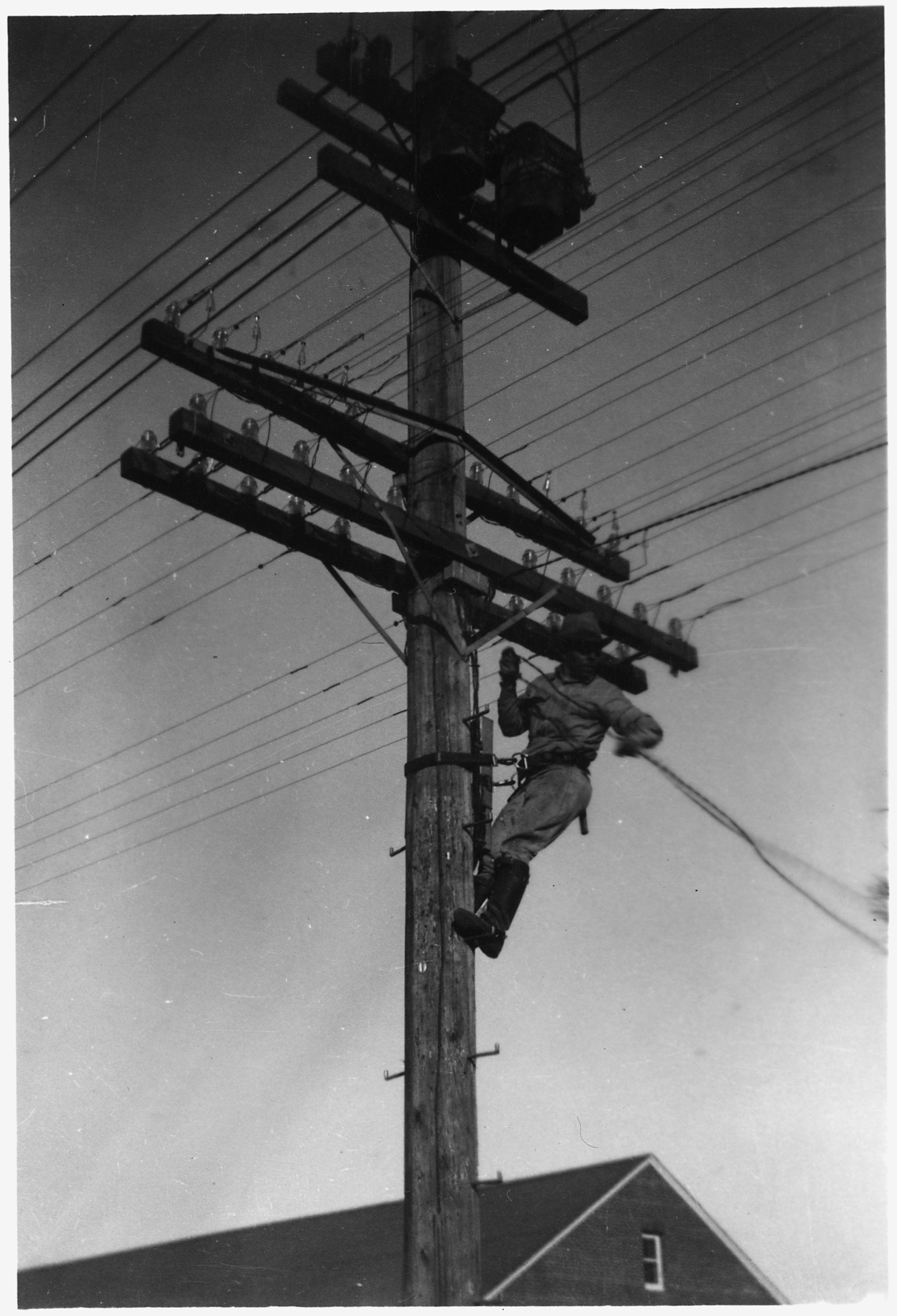
The math is not forgiving. About 819,000 electricians are employed in the U.S. today per the Bureau of Labor Statistics. Fortune puts the country’s incremental need over the next decade at more than 300,000; Microsoft’s own figure is half a million. Microsoft also estimates roughly 200,000 of the current fleet will retire over the same window. Wages are up 25 to 30% in two years, and apprentice intake is climbing. Journeyman status still requires a four- to five-year apprenticeship, so the 2026 intake arrives on job sites in 2030 or 2031.
The classroom to watch is IBEW Local 26, which covers Washington, D.C., and the Northern Virginia corridor and does almost all of the union work on the big campuses. Apprentice intake and membership have both climbed every year of the boom, and top journeymen in the corridor clear $200,000 with overtime. The country’s most aggressive electrical-apprentice pipeline runs in the country’s largest data-center corridor, and it is not enough.
Uptime Institute’s 2025 survey found that 52% of data-center construction firms reported that staffing shortages had caused disruptions, up from 43% the year before. Oracle, in December 2025, pushed construction completions from 2027 to 2028 and named labor as one reason.
Even at full apprenticeship throttle for a decade, the age arithmetic still compounds. The transformers will ship two years late, and the journeymen to wire them in will not be certified yet.
Saying No
And then there are the people who said no. Raudabaugh was one, and the numbers around him are growing.

Prince William County’s Digital Gateway was, at 2,100 acres, one of the largest data-center campuses ever proposed. The Virginia Court of Appeals voided its rezonings in March 2026, and the Board of Supervisors voted not to appeal. The county was finished with it. The developer was not: QTS filed its own appeal to the Virginia Supreme Court in late April 2026, where a writ panel will decide whether the project gets one more life.
Fauquier County’s “Gigaland,” a 202-acre campus near Remington, was recommended for denial 4-1 by the Planning Commission in 2025.
Chesterfield County’s Planning Commission voted unanimously against a 740-acre campus the same year.
Balico withdrew its Pittsylvania County project one day before the board vote, after the Planning Commission recommended denial.
In Manassas, residents measured 67.4 decibels at their bedroom windows, next to an AWS campus. The county’s nighttime residential ordinance allows 55.
In late 2025, the Virginia State Corporation Commission approved a new rate class for Dominion Energy’s large-load customers, to take effect January 2027. AI data centers will pay at least 85% of their contracted transmission-and-distribution demand and 60% of their generation demand, separated from the residential book where those costs had been riding. Dominion serves 2.7 million residential customers in Virginia. Their bills rise $11.24 a month in 2026. The Commission attributes that increase to grid capital and authorized return on equity rather than to data-center load specifically; the new rate class is the separate mechanism meant to keep the next four years of data-center growth off the residential bill.
And then there is the litany.
Moratoriums enacted through 2025, from DeKalb to Clayton.
Including Fulton County’s one-year ban, by December 2025.
LD 307, a 3-year moratorium on data centers above 20 megawatts, passed both chambers. Governor Mills vetoed it on April 24, 2026; the House failed to override, 72-65, on April 29. No ban took effect — Mills created a data-center advisory council instead.
The circulating memo became a bill. Senate Bill 1359, a three-year moratorium on hyperscale data centers, was formally introduced June 1, 2026 with bipartisan sponsorship.
Chandler denied a rezoning. Tucson denied Project Blue, a $3.6 billion, 290-acre campus, inside city limits; Pima County approved a scaled version on unincorporated land in December 2025.
New data centers built or in development since 2022 sit in counties already under high water stress, per Bloomberg’s analysis.
The list is not complete. It is growing.
In the weeks after this piece first ran, the list did more than grow. It changed kind. The refusals that had been scattered across porches and planning commissions started to clear the statehouse. In June 2026, New York’s legislature passed the Responsible Data Center Development Act, a one-year moratorium on data centers above 20 megawatts with separate electricity and water rate classes attached. It cleared both chambers by wide margins and went to Governor Hochul’s desk. If she signs it, it is the first statewide data-center moratorium in the country. A different axis opened in Oklahoma, where the Muscogee Nation’s National Council rejected a hyperscale campus outright and the Seminole Nation passed a moratorium 24-0, barring even inquiries. Sovereignty turns out to be a form of zoning the check cannot reach.
The aggregate has a number now. Data Center Watch counts 188 local opposition groups across 40 states, with project cancellations that rose from six in 2024 to twenty-five in 2025 to more than twenty in the first quarter of 2026 alone. That last figure is a single quarter.
It does not always hold. In Saline Township, Michigan, residents voted down a 575-acre OpenAI and Oracle campus four to one. The developer sued on exclusionary-zoning grounds, settled for about $14 million, and broke ground anyway. A local “no” turns out to be a vote, and a vote can be bought back in court. That is the other half of the pattern: the refusal is real, and so is the machine for routing around it.
The workarounds are the evidence
The Morris family lived a thousand feet from the fence line of Meta’s Stanton Springs data center in Newton County, Georgia. Their well failed inside a few months of the center opening. The joint development authority that approved the campus had run no pre-construction hydrology study, and Meta’s draw of roughly 500,000 gallons a day was not modeled against the private wells it would help drain. Newton County’s own planning documents project water-deficit status by 2030. The Morrises are on tanker deliveries now, a thousand feet from a company whose 2026 capex guidance is $115 to $135 billion.
That is the workaround on the water side. On the grid side, the workaround is a private grid built on top of the public one. Every deal that pulls load off the shared grid leaves residential, small commercial, and existing industrial customers to carry the fixed costs. The private grid is built on top of the public one, and its construction is paid for by the people still on the public one. The Virginia Commission just ended that subsidy from one direction, and it is starting to arrive from several others.
Some started by turning to nuclear power. On September 20, 2024, Constellation and Microsoft announced the restart of Three Mile Island Unit 1, which had been shut down since 2019. The plant is now branded the Crane Clean Energy Center. Restart requires rehiring or retraining roughly three hundred skilled workers and running through a federal licensing process that has never been attempted for a reactor that formally entered decommissioning. The target is now 2027. All 837 megawatts of output are contracted to Microsoft under a twenty-year power-purchase agreement. There is no public offtake. The plant that ran as a shared utility from 1974 to 2019 will come back as a private one.
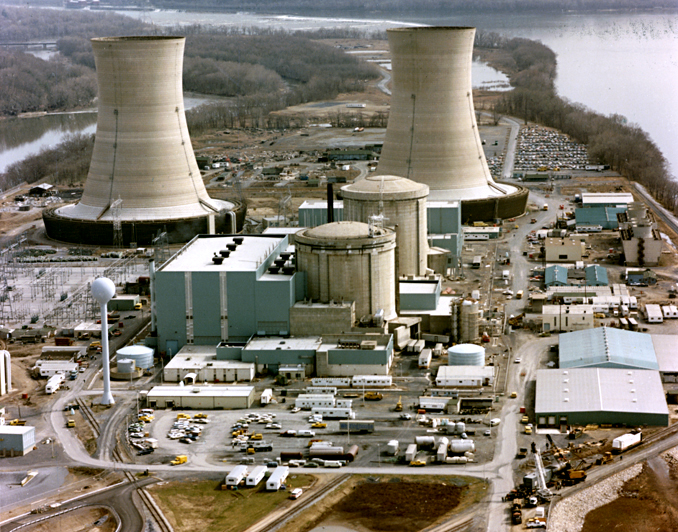
The pattern repeats across the other three hyperscalers. Meta is financing 5.2 gigawatts of new natural gas in Louisiana, plus 240 miles of 500-kilovolt transmission and battery storage, for a single data center in Richland Parish. Amazon, after FERC rejected its behind-the-meter Susquehanna deal twice, restructured it into a 1.9-gigawatt ramp through 2042. Amazon’s Project Houdini prefabricates data-room modules in factories and trucks them to AWS campuses across the country. NextEra is restarting Duane Arnold in Iowa by 2029 under a twenty-five-year PPA with Google, and a separate Google contract with Kairos Power and TVA puts a small modular reactor at Oak Ridge by 2030. Each of these deals routes power from a generation asset directly to a single buyer.
These workarounds are the shape a utility takes when it cannot deliver on time. In aggregate the effect looks like a private parallel grid, even when each hyperscaler is contracting with existing utilities rather than becoming one. The public grid has told them through auctions and queues and FERC orders that it will not be ready. The workaround is legal, and the cost is socialized. The private parallel grid is being built at the speed the capex window can support, and the public one is being left to absorb what cannot be moved.
The permits, or the absence of them
On April 14, 2026, the NAACP, the Southern Environmental Law Center, and Earthjustice sued xAI in federal court in the Northern District of Mississippi. The complaint describes 27 methane gas turbines running in Southaven without an air permit, powering xAI’s Colossus 2 data center across the state line in South Memphis. By its own manufacturer-supplied figures, the facility emits more than 1,700 tons of smog-forming nitrogen oxides a year, 180 tons of fine particulate, 500 tons of carbon monoxide, and 19 tons of formaldehyde. Greater Memphis was already failing federal ozone standards. The nearest elementary school is a mile away.
In the weeks since, the case has only escalated. By the time the plaintiffs moved for an emergency injunction on May 6, the unpermitted count had risen to 33 turbines, with roughly 46 on site and estimated nitrogen-oxide emissions near 2,500 tons a year. Then the federal government weighed in, not against the pollution but against the plaintiffs: the Department of Justice filed notice that it may intervene on xAI’s side, citing the administration’s executive order on American AI dominance. xAI, for its part, disclosed plans to buy $2.8 billion more turbines. The objection that a school a mile away could not move the company now has a federal thumb on the company’s side of the scale.
This is not xAI’s first site. Between mid-2024 and mid-2025, SELC and local groups documented 35 methane turbines running at xAI’s original South Memphis campus against a permit for 15. In July 2025 the Shelby County Health Department issued a permit for those 15 turbines to run around the clock and declined to act on the rest; xAI later removed the excess units there, and the permit for the remaining fifteen is itself under appeal. The second facility opened while the first was still being fought.
The xAI case is the loudest example, not the only one.
A September 2025 DEQ guidance memo redefines “emergency” to include utility-scheduled outages up to two weeks long. The corridor east of Loudoun County is already in ozone non-attainment. During the June 2025 heat wave, Loudoun residents reported nearby data centers running backup generators nonstop.
The Morris family’s well failed within months of Meta’s data center opening 1,000 feet away. The joint development authority conducted no pre-construction hydrology studies. Newton County projects water-deficit status by 2030.
Coal retirements at Bowen and Scherer were pushed from their prior schedules to January 2039, citing 9,400 megawatts of new data-center demand. Southern Company appears to have abandoned its prior net-zero commitment in the process.
The first new gas plant approved under Virginia’s Clean Economy Act, sited adjacent to the Dutch Gap conservation area. The Chesterfield NAACP, Appalachian Voices, and Mothers Out Front have appealed the DEQ air permit.
The pattern is install the equipment before the permit is issued, redefine “emergency” until the generators can run, file water requests and treat the cumulative draw as someone else’s problem, and extend the coal plant that was supposed to retire. The market told the hyperscalers through FERC orders and auctions that the public grid would not be ready in time. The response has been to construct the missing capacity quickly and under whatever permitting regime can be bent closest to the schedule.
The map above carries the same story in two marker types. The gold dots are the places saying no. The triangles are the places where a data center is already running without the permits, or the water, or the retirement schedule it was supposed to honor. They are often the same places.
I’ll pause for a bit with facts and figures and return to something that’s sticking with me. I keep coming back to the elementary school a mile from the Southaven turbines. A mile is walking distance. It would be a drop in the bucket for the company or founder to protect these kids and not bat an eye at the cost of improving the school or building a new one. The complaint is on file, the map coordinates are public, and nothing about the situation is concealed. They act with an impunity that is heartbreaking. I would like the essay to end here, at the school and the formaldehyde, and it cannot. There is an arithmetic left to run, and the arithmetic is part of how this keeps happening.
The arithmetic
Time, consent, and people willing to build in the physical world are the constraints, and capital cannot manufacture any of the three in twelve months. The $700 billion holds up against all three and, to varying degrees, loses.

Some of it comes down at the margins. Microsoft walked away from two gigawatts of leases in late March 2025, AWS delayed parts of its lease portfolio, and Oracle slipped its schedules. Data Center Watch counts $156 billion in data-center projects blocked, canceled, or stalled in the year, against a hyperscaler 2025–2027 capex pipeline north of $1.5 trillion. The market clears itself the way a market does when a number outruns a factory, in ones and twos.
JS Tan argues the opposite: that the buildout itself is evidence America can still build physical infrastructure at speed when powerful actors align. He is right about the places where it works. In Loudoun, Richland Parish, and Southaven, the buildout is fast because residential zoning, air permit deadlines, water requests, and coal retirement schedules have all bent around the schedule of the data center. The buildout is reproducible only in a county willing to trade the same things in the same order. What that makes is not industrial policy but jurisdictional arbitrage, priced in air, water, and coal.
The rest holds, and the cost lands somewhere else: on the residential ratepayer in Northern Virginia, on the water table in Maricopa County, on the coal plant PJM cannot afford to retire on the climate schedule, on the air a mile from an elementary school in Shelby County. It is a ratepayer transfer, an air-permit workaround, and a coal-retirement delay. No one on the ledger signed for it, and everyone on the ledger will pay for it.
No single actor chose this, and the outcome is one no reasonable country would have chosen. Cleveland-Cliffs’ engineers, FERC commissioners, PJM traders, county supervisors, hyperscaler capex teams, IBEW organizers, the farmer with the easement: people in their respective positions are producing in aggregate the outcome we are now assembling. It is a system, and it is also a set of choices, most of them recoverable and some of them not.
Some of those choices cannot be taken back. A coal plant kept running past its climate date does not give those tons of carbon back. Groundwater drawn from a stressed aquifer does not refill on the schedule an earnings call prefers. A child who breathes formaldehyde on a school morning has breathed it, and the independent dispersion modeling puts elevated health risk from the Southaven turbines well past a single mile. The natural systems the buildout is drawing on are ones the country will need again, and is spending ahead of time.
The test
The real question this essay has been working toward is not whether the $700 billion will be spent. It will be. The question is what it is testing. Every system the country has built in the last century is on the bench at the same time (the grid, the aquifer, the air permit, the property tax base, the planning commission, the bond market, the household electricity bill), each asked the same question: can you absorb this? The answers are mostly “yes, at a cost we did not budget for.”
Two other jurisdictions are running the same test on different inputs. China is running it with state-coordinated electricity priced below the U.S. floor and a political economy that does not require county-commissioner approval for where the campus goes. The result, among other outputs, is a frontier model at a fraction of the U.S. token price, open weights, and a trend line on the open-model routers that crossed half the market at its peak. The European Union is running it with the opposite weights: environmental review on every site, rate-limited data-center growth, municipal water prohibited past threshold for cooling. The EU is behind on capacity and ahead on rules. China is ahead on capacity and running a different ledger on who pays. The United States is running it through the back door of private deals on a public grid, with the bill landing on households and airsheds and coal schedules that were supposed to be retired. And lately the federal government has begun to take the buildout’s side against the people refusing it: the Justice Department signaling it may intervene for xAI’s unpermitted turbines, the State Department cabling foreign capitals about DeepSeek the same week the cheaper model shipped. The local “no” now runs into a national “yes.”
*Total AI demand and largest training cluster are Aschenbrenner's back-of-the-envelope projections, not measured figures. China and USA lines are actuals through 2024 (EIA, Ember); dashed extensions are projected.
All three are testing the same question. What should a country optimize for when the machine it is building needs the same three inputs the people already need? Land, water, and electricity are what a human needs to live. They are also what a data center needs to function. The argument of the last year has assumed, quietly, that the machines should get them first. The market thinks it is allocating capital. It is actually allocating the commons.
My position, after looking at this for this long, is that the priority is inverted. If we want AI to be what its builders promise, a net good that pays for itself in better medicine, fewer accidents, cheaper education, it has to run on systems whose basic costs for humans are falling, not rising. A country that wants frontier AI needs electricity, water, and land that its residents can also afford, and it has to build for all of that at once. It cannot buy the first by draining the other three. The test this buildout is running right now says, in aggregate, that the country will drain the other three. That is what failure looks like when failure is also the plan: the inferences run, the bills arrive, and the people who use the outputs are not the people who paid for them.
None of this is just happening to the country. The country is an active participant. What I keep coming back to is that there is no future for a people who put the needs of machines ahead of themselves with hopes, the machines will prioritize that differently.