Sandman Mode: a red-only night filter that doesn't invert your screen
Night Shift removes half. It does not remove the band.
Night Shift is the default answer on a Mac, and it does something measurable. At its warmest setting the display sits around 2800–3000 K. Patrick Mineault measured the screen with a colorimeter. He calculated that Night Shift cuts melanopsin-weighted light by about 52%. About 42% of the 460–490 nm band remained.
Melanopsin is the photopigment in the retinal ganglion cells. Those cells signal the suprachiasmatic nucleus, the brain’s clock. Its response peaks around 480 nm, and LED backlights spike around 450–460 nm. Night Shift’s warmest white point still leaves a share of that band. The Kelvin number describes how warm the screen looks; the spectral measurement describes what is left.
The reduction is real. It is not the same as removing the band. Night Shift shifts the white point. It scales the channels; it does not set the blue channel to zero. What remains is the part that matters if the goal is to remove the short-wavelength signal rather than warm it. Apple documents the setting, not the transform; the evidence is the measurement.
A white-point shift keeps the channels proportional. A channel cut sets two of them to zero. If the sleep signal is driven by the 460–490 nm band, the second operation removes more of it.
Mineault’s conclusion is that blue-light filters do not do much, and his measurement supports him. I am making a narrower claim. A warmer white point is the simpler tool. Removing the blue and green channels is a different operation.
f.lux already goes red. It inverts the screen.
f.lux has used the gamma table for years. Its default night setting bottoms out at 1900 K, and the wider ranges go to 1200 K or 800 K. That matters because the gamma table is the layer where a channel can be set to zero. Night Shift applies its transform above that table. f.lux and Sandman work in it.
f.lux’s own documentation says Darkroom removes 100% of blue and green light and inverts colors. Darkroom is built for dark adaptation, where a flipped screen is an acceptable trade. That is a different job from reading an interface.
The cost is the interface. The short-wavelength band is gone, and the screen flips. Every color inverts. For some work that is fine. For reading text, writing code, or clicking through a settings panel, it is a different screen than the one the designer built.
The current f.lux Mac release is dated June 2023, and that is the download available today.
How Sandman works
A gamma table is a list of 256 values for each channel. The display pipeline reads the table and maps the framebuffer’s value to the panel’s output. Sandman writes zero into every blue and green entry. The red entries stay where they are.
An 8-bit channel has 256 entries. Setting every blue and green entry to zero means the panel receives no blue or green signal from the framebuffer. The red channel still carries the image, so text, contrast, and layout survive even though color does not.
Red is the only channel left, so the image is a red monochrome. Contrast and text survive because the red channel still has 256 levels. What disappears is hue: a blue link and a green button can land on the same red value. That is why color work is impossible. Reading still works.
The red channel keeps the display’s brightness curve, so the screen stays readable instead of becoming a flat red silhouette.
The table sits below the framebuffer. Screenshots and screen recordings capture the framebuffer, so they keep full color. The filter is visible to the eye and invisible to the capture path. There is no overlay window and no per-frame work.
A scheduler computes sunset and sunrise from the system timezone, so there is no location prompt. It wakes about once a second to check for shutdown and the next transition. That is not zero CPU. It is a small, predictable wake. It restores the original tables on quit, crash, or signal. It does not call a network service.
macOS gets a menu bar app. Linux and Windows get a CLI. The core is Rust. The Linux path needs X11 or a wlroots-based Wayland compositor: Sway, Hyprland, Niri, or Wayfire. GNOME and KDE do not expose gamma tables. Windows needs a one-time administrator setup before it will accept a full blackout of two channels. The filter applies to every display the OS exposes through its gamma API.
What it costs
Everything is red. The point and the cost are the same thing. Color judgment, photo editing, and brand swatches are out. Turn it off first.
The panel still emits a little blue. The backlight is white and the panel’s color filters are not perfect. The LUT removes the signal, not the physics. HDR is off, so an HDR video looks flatter than it does with the filter off. The filter does not dim the backlight, so a bright room still calls for a lower brightness setting.
HDR is disabled while the filter is active. macOS 14 or later is required. Gatekeeper blocks the first launch until it is allowed. Some M5 Pro and Max Macs on macOS 26.3–26.4 have a gamma-table bug that affects other gamma-based filters too. Check the macOS version before relying on any of them.
Windows needs an administrator-level registry change (sandman setup). Reboot before the display will accept the full ramp. Linux is X11 or wlroots Wayland, not GNOME or KDE. The current release is 0.1.6. There is no auto-updater, so the lab page is the place to check for a new build.
Color accuracy and a warmer white point are different jobs. Night Shift is already on the Mac and handles the warmer-white-point job. The reason to use Sandman is specific: the goal is the blue and green channels gone without an inverted interface.
The comparison
The difference is the inversion: Night Shift cannot zero the channels, and f.lux’s Darkroom zeroes them but flips the screen. We can measure the difference instead of arguing about the tint.
At the warmest setting, Night Shift leaves about 42% of the 460–490 nm band. Sandman leaves none in the signal; panel leakage and 8-bit quantization remain. Both Sandman and f.lux are free, though f.lux’s free tier is for personal use. Sandman has no account and no paid tier. Sandman’s source is private, as is f.lux’s; Night Shift ships with macOS. Sandman schedules from the timezone. f.lux uses location.
Screenshots are unaffected on all three. This is parity, not an advantage. The private source is not a win either; I list it so nobody goes looking for a repository.
What free means
Sandman is free to download and use. There is no account, no telemetry, and no upsell. The app has no HTTP client and no payment code. The only URLs in it are links in the About dialog.
There is no account to create, so there is nothing to cancel. The app does not check for updates or send a heartbeat, and there is no server behind it. The source is private, so if you need to audit the code, this is not the tool. There is no trial timer and no feature gate. Free means free to use.
Download
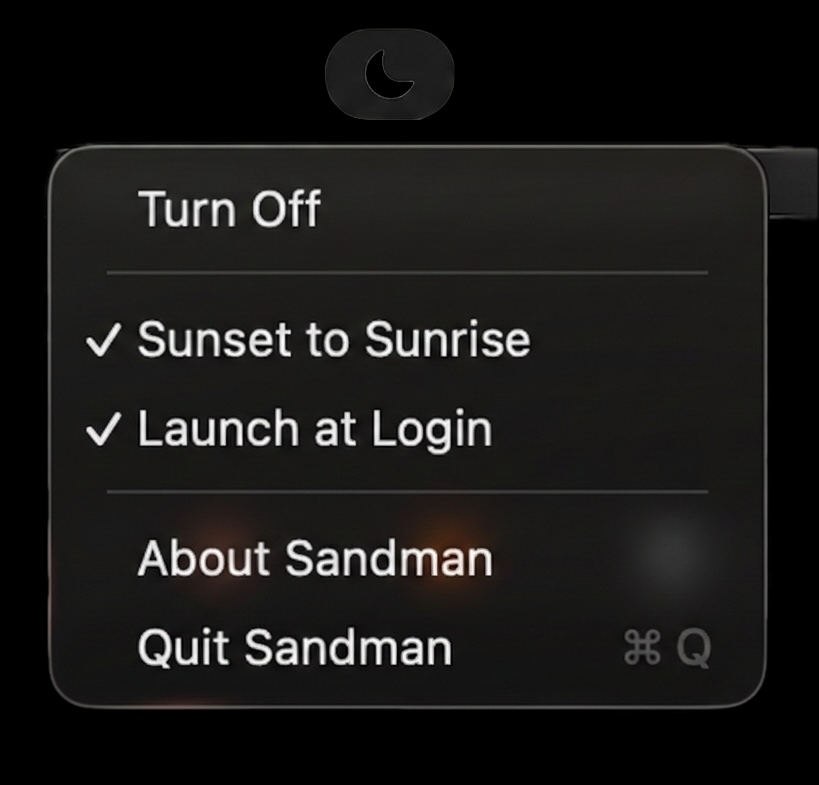
Download from the lab page. It has the macOS DMG for Apple Silicon and Intel, the Linux binary and .deb, and the Windows .exe. The macOS build is a menu bar app; Linux and Windows are CLIs. Version 0.1.6.
Three questions
Why not just use f.lux Darkroom?
Darkroom works if a flipped screen is acceptable, as it is for stargazing. For work in an interface, it is the wrong tool.
Does it work on external monitors?
Yes. It applies to every connected display. Each panel still leaks a little light, and HDR is off while the filter is active. If a display ignores gamma tables, Sandman cannot fix that.
Can I do color work with it on?
No. Everything is red. Turn it off before grading, retouching, or picking a color. The original tables come back on quit or toggle-off.
The short version
Sandman Mode is a small tool for one job: remove the blue and green channels without inverting the interface. It is free, it runs on three platforms, and it costs you color accuracy while it is on. If that trade fits, the download is on the lab page.