Creating a Home for Intelligent Media

From WALL-E.
I was saddened by the news that Gigaom was shutting down Tuesday. That said, I can’t claim to have lost my job like Laura Hazard Owen. Re/code and Gigaom have consistently been my two favorite tech news sources.

James Nachtwey for TIME
Distraction is the only thing that consoles us for miseries and yet it is itself the greatest of our miseries.
— Blaise Pascal
Platforms are becoming more visual, quicker, and focusing on shorter and shorter content. Medium (this website), recently left its long-form roots to embrace random thoughts and link-sharing.
Find success in Social Media by following the three-P’s: preach, polarize, and pander.
Twitter has evolved to be more vibrant visually. Constructing a great Tweet is no longer a simple text message. Barriers keep rising, distribution doesn’t scale, and cross-fit badass and Twitter CEO, Dick, says it’s cool if you don’t post anymore. Meanwhile, behind the blue walls, Facebook continues to reduce clickbait by focusing on time-spent on external links, publishers are realizing that they need to be more and more creative to grab people’s attention. Incredibly, both Facebook and Twitter are increasing the cost for both content creation and distribution to be successful. Moreover, they’re requiring contributors to post more content to surf trends and maintain relevance. Basically, they’re expecting users and brands to make a full-time commitment to their platforms to be successful.
Can Sharing Ideas Be Simpler?
The two questions we should all ask ourselves:
- Why do I need a captive following?
- How often do I actually need to speak to a large audience?
If you’re a media company, your answers are simple:
- Because it’s my core business
- All day, every day
For the rest of us, including most product companies, we may need an audience for major personal updates (#humblebrags), news that impacts the community, milestones, a crazy epiphany, or a launch (see ProductHunt). Meanwhile, the community could come together to discuss what’s next and accelerate progress.
Why can’t we work together to build a shared audience rather than competing to own one?
Aside: Help me understand why you need a captive audience and couldn’t be successful in a shared community context?
Thoughtful publishers and content creators should nurture platforms that aren’t engineered to, eventually, kill them. Facebook and Twitter, or, more generally, peer-to-peer networks scale poorly. They always will become plutocratic networks where a relatively small group of entities hold all the distribution power.
The solution and our future is in Community Media platforms.
Four Qualities of Community Media Platforms
We-first vs Me-first —Platforms where the core dynamic is building a following are Me-first platforms. They focus the user on building a following so they may have a voice. Rather then assuming that every person has intrinsic value, each and every person starts from scratch and has to re-build their network. Me-first networks generally have a massive early-adopter bias which stifles the success of users who join late.
We-first networks like HackerNews, Kapuno Communities, Digg (old version), Reddit or ProductHunt focus their users on being helpful to others as a means of building a reputation. Subtle but very important is the fact that the priority in the information architecture (IA) is on the content not the speaker.
‘Vote’ vs Re-Share —A community network’s distribution is built on top of voting algorithms, and may be able to offset for the bias of social on judging the quality of the content. Offsetting bias is key because existing networks provide some huge followings which skews content’s engagement but doesn’t necessarily mean the content is actually “good.” This would mean you’d examine each vote based on the relationship of the voter to the content creator.
Engineered to Drive Interested Audiences to External Sites —Platforms that fail to provide organic (non-paid) distribution to links to external content are essentially expecting producers to grow the platform for free. This is amoral (yes, there is a morality to product design) and an incredibly thoughtless design. Writers and content-creators should bias towards platforms which successfully distribute their quality links and drive interested readers to their properties, subscription lists, and shopping carts.
Day-Zero Distribution Value —Imagine a 14 year old genius was born in to an underprivileged low-income home. The family lacks resources, mentors, and the network on or offline to nurture the child’s curiosity. Against all odds, and with the help of the internet, the child discovers how to build a better battery system. They build a prototype, film a video with their friend’s iPhone, and upload it to their sparse YouTube account.It gets no views. They take the video, create a Twitter account and their first tweet is their discovery.*Would they reach the right scientists and technologists? *The day-zero distribution value assumes that a person can join, share with no prior history on the platform, and there is an available audience which has the ability to decide the merits of the content.
A community media platform would provide a space for this young genius to join and share their idea with others who may be able to help them move the idea forward or, simply, promote it on to their own audience.
Yes, Publishers Still Need to ‘Own’ An Audience
Until now, I’ve been talking about trends, the problems with existing platforms and why you should find and engage on community media platforms. However, I realize that publishers still require a predictable audience so they can effectively monetize it. My recommendations don’t hope to say anyone should stop using SM; rather, it’s that there is more value to focusing efforts elsewhere to build for a more sustainable future.
Content creators should continue to build their following on Twitter, Facebook and elsewhere by engaging with large communities outside of their own followings and off their platforms.
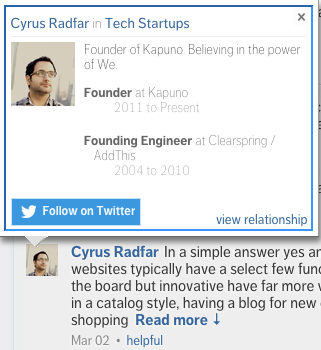
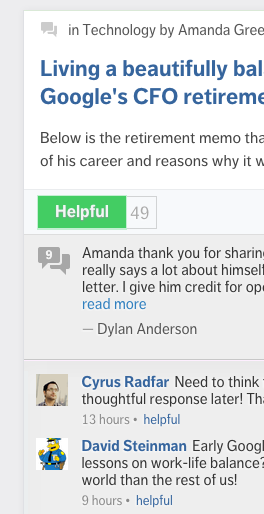
Screenshot from a contribution I made on Kapuno Communities
[ Bias alert: The fact that there was no safe sustainable place for thoughtful content was the reason why we founded Kapuno Communities. ]
On Kapuno, we purposely don’t have following on network. It’s a huge difference between us and most of the others who just follow the status quo and don’t attempt to re-think the impact of creating another peer-to-peer network.
We have a button (pictured above) to follow the member on Twitter on their profiles and anywhere you see their name. Also, as a thanks to our helpful members, we also promote their Twitter account in our community feeds.